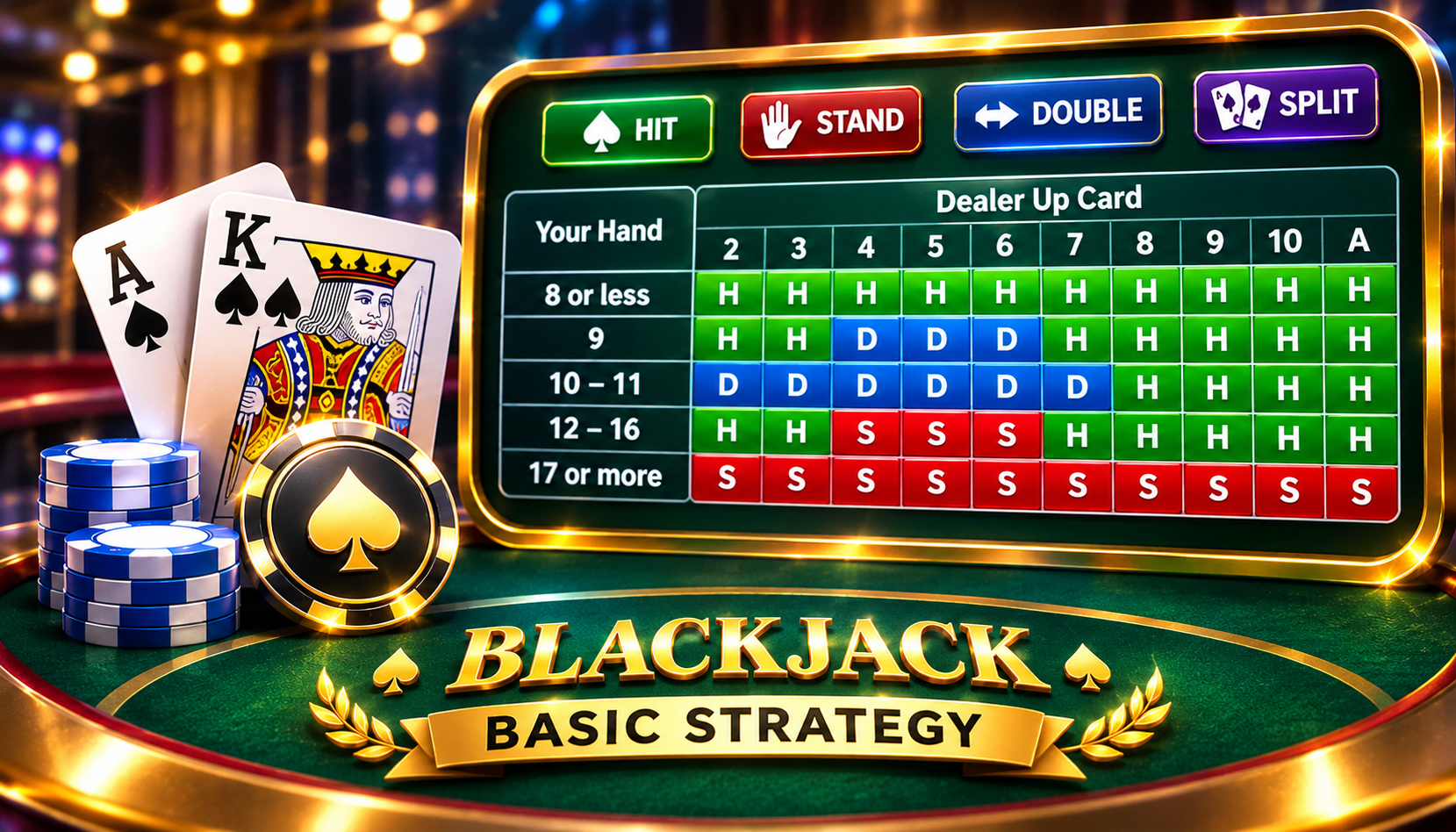
Sit at any blackjack table and you will notice that some players hesitate over every decision while others act almost instantly. The quick ones are not guessing. They are following blackjack basic strategy, a set of proven moves that tells you the best action for every combination of your cards and the dealer’s visible card. Once you learn it, the game becomes calmer, faster and far more enjoyable, because you always know you are making the smartest possible choice.
This guide explains blackjack basic strategy in a clear, practical way. It covers why the strategy works, how to play hard hands, soft hands and pairs, when doubling down pays off, why insurance is a trap and how table rules can make a big difference. By the end, you will have a reliable framework to bring to any table.
Why a Strategy Exists for Blackjack
Most casino games give players no meaningful decisions. Blackjack is different. After the cards are dealt, you choose whether to hit, stand, double down or split, and those choices genuinely affect the outcome over time. The dealer, meanwhile, must follow fixed rules, usually drawing until reaching 17 or more.
Blackjack basic strategy was developed by analysing millions of possible hands with computers. For each situation, the analysis identified the move with the best long term result. Following it consistently can lower the house edge to around half a percent on tables with favourable rules, which is among the lowest in any casino.
What the Strategy Cannot Do
Basic strategy improves your decisions, but it does not remove the house edge or guarantee wins in any session. Short term results will always vary. Its purpose is to make sure you never give away value through poor choices.
Playing Hard Hands
A hard hand is any hand without an Ace, or with an Ace that must count as one. These hands carry the risk of busting, so the dealer’s upcard plays a big role in each decision.
With a hard total of 17 or higher, always stand. With 13 to 16, stand when the dealer shows a 2 through 6, because the dealer has a good chance of busting, and hit when the dealer shows 7 or higher. With a hard 12, stand against a dealer 4, 5 or 6 and hit against everything else. With 11 or less, you cannot bust with one card, so you should always take another card or double down where the strategy recommends it.
Doubling Down on Hard Hands
Doubling down means doubling your bet in exchange for exactly one more card. It is one of the most valuable moves in blackjack basic strategy when used correctly. Double on a hard 11 against most dealer upcards. Double on a hard 10 when the dealer shows 2 through 9. Double on a hard 9 when the dealer shows 3 through 6. In other situations with these totals, simply hit.
Playing Soft Hands
A soft hand contains an Ace counted as 11, such as Ace and 7, which makes soft 18. Because the Ace can switch to a value of one, you cannot bust by taking a single extra card. This flexibility changes the correct moves.
Soft 19 and higher should usually stand. Soft 18 is the trickiest soft hand. Stand against a dealer 2, 7 or 8, double against 3 through 6 where allowed, and hit against 9, 10 or Ace. With soft 17 or lower, never stand. Instead, double against the dealer’s weaker upcards where allowed, usually 3 through 6 for soft 17 and 5 or 6 for the lowest soft hands, and hit in all other cases.
Splitting Pairs Correctly
When your first two cards have the same value, you may split them into two separate hands by placing an additional bet. Correct splitting is an important part of blackjack basic strategy.
The Two Golden Rules
Always split Aces and eights. A pair of Aces gives you two strong starting hands, while a pair of eights makes 16, the weakest total in the game, so splitting turns one poor hand into two better chances. Never split tens or fives. A pair of tens already makes 20, and a pair of fives makes 10, which is better played as a doubling hand.
Other Pairs
For other pairs, follow the dealer’s upcard. Split twos, threes and sevens against a dealer 2 through 7. Split sixes against a dealer 2 through 6. Split nines against a dealer 2 through 9, except 7, where you should stand. Split fours only against a dealer 5 or 6, and only when you are allowed to double after splitting.
Why Insurance Is a Trap
When the dealer shows an Ace, you may be offered insurance, a side bet that pays two to one if the dealer has blackjack. It sounds like protection, but the dealer completes blackjack less often than the payout requires for the bet to break even. Over time, insurance loses money, which is why blackjack basic strategy advises declining it every time, including the even money offer when you hold a blackjack yourself.
Table Rules That Matter
Not every blackjack table offers the same value. The most important rule to check is the payout for a natural blackjack. Tables that pay three to two are far better than tables paying six to five, which significantly increases the house edge.
Other rules matter too. Tables where the dealer stands on soft 17 are slightly better for players than those where the dealer hits. Fewer decks, the option to double after splitting and the ability to surrender are all favourable. Australian players should also be aware that many local land based casinos use a no hole card rule, where the dealer only takes a second card after players have acted. This makes doubling and splitting against a dealer 10 or Ace riskier, so check how your chosen online table handles the dealer’s second card.
Learning the Strategy Step by Step
Trying to memorise every move at once can feel overwhelming. A simpler approach is to learn in stages. Start with hard hands, since they make up most of the hands you will play. Then add the splitting rules, beginning with the golden rules for Aces, eights, tens and fives. Finally, learn soft hands and doubling.
Keeping a strategy reference beside you while you practise is perfectly acceptable for online play. Over time, the decisions become automatic, and you will find yourself relying on the chart less and less.
Putting Blackjack Basic Strategy Into Practice at AUSWIN Casino
The best place to practise is a table with clear rules and limits that suit your budget. For Australian players who want to sharpen their skills, AUSWIN Casino brings blackjack together with live dealer tables, pokies and other casino games in one account that works smoothly on mobile and desktop.
Start at a digital table with low limits, where you can control the pace and take time over each decision. Once the moves feel natural, try a live dealer table for a more social, studio style experience.
Checking Table Rules First
If you are unsure whether a table pays three to two, whether the dealer stands on soft 17 or whether surrender is available, you can ask AUSWIN live chat about blackjack table rules before you sit down. Choosing the right table helps blackjack basic strategy work at its best.
Mistakes That Cost Players Value
One of the most common mistakes is playing on instinct instead of strategy, such as standing on 16 against a dealer 10 because it feels safer. Another is refusing to split eights or double down because it means placing more money on the table. Copying the dealer’s rule of always hitting until 17 also gives away value.
Raising your bets after a losing streak is another mistake. Basic strategy guides your decisions, not your bet size, and no system can change the randomness of the cards.
Play the Right Way, Stop at the Right Time
Blackjack basic strategy gives you the best possible decision on every hand, but it does not change the fact that blackjack is a game of chance with a house edge. Treat each session as entertainment, set your budget and time limit before you sit down and leave the table once you reach either one.
If you notice yourself breaking strategy out of frustration, chasing losses or playing longer than intended, take a break and use the deposit limit and time out tools in your account. Knowing when to step away is just as valuable as knowing when to hit or stand.